Healing America’s Narratives: Trauma

[Part of a series, this essay continues our exploration of Healing America’s Narratives: The Feminine, the Masculine, & Our Collective National Shadow. Now available.]

Photo by Stormseeker on Unsplash

In The Myth of Normal, Dr. Gabor Maté writes that “[t]he meaning of the word ‘trauma,’ in its Greek origin, is ‘wound.’ Whether we realize it or not, it is our woundedness, or how we cope with it, that dictates much of our behavior, shapes our social habits, and informs our ways of thinking about the world.”¹

Dr. Bessel van der Kolk, in The Body Keeps the Score, is clear that “trauma is NOT the story of what happened a long time ago; trauma is residue that’s living inside of you now…in horrible sensations, panic reactions, uptightness, explosions, and impulses.”² He reminds us that trauma is not limited to combat veterans, refugees, or victims of violent crimes or natural disasters. “Trauma happens to us, our friends, our families, and our neighbors,” and it “affects not only those who are directly exposed to it, but also those around them.”³

Individual trauma can result from a one-time event or from exposure to repeated events like ongoing childhood abuse or neglect (known as complex trauma). Collective trauma impacts groups of people (war, slavery, genocide, natural disasters, etc.). Intergenerational (aka historical or transgenerational) trauma is carried forward through generations, biologically, experientially, and psychologically. Secondary trauma arises when one is exposed to the firsthand traumatic experiences of another. These are not mutually exclusive categories.

In varied iterations, trauma informs our national Shadow and is a core aspect of our history.

The subjugation of women still plays out in many ways, just one of which is the unprecedented rates of anxiety, depression, and suicide among our teenage daughters.⁴

The betrayal and slaughter of Native Americans still plays out in disproportionate unemployment, disease, and low life expectancy, especially on reservations.

The kidnapping, enslavement, and lynchings of Africans and African Americans still plays out in disproportionate susceptibility to specific diseases, mass incarceration, and less access to quality health care.

The effects of every war we’ve engaged in still plays out in the primary trauma of our combat veterans, the secondary trauma of their families, the collective trauma they share, and the intergenerational trauma that has been passed down for centuries.

We are all impacted, at varying levels, by our daily rituals of violent crime, our lack of equitable access to affordable health care, increasingly intense and more frequent natural disasters, “active shooter drills” and actual shooters for our school children, employees, shoppers, and others, and the global residuals of the COVID-19 pandemic. The list continues and it is long.

We are not suggesting here that the intergenerational trauma that is passed down to someone whose life seems otherwise okay carries with it the same immediate experience as the primary trauma of a combat veteran, a victim of violent crime or natural disaster, or those who have been abandoned or neglected. We are suggesting that Americans live in a country that remains an experiment, and that the experiment involves ongoing trauma.

We were conceived through the fertilization of ideas that gave voice to some and subjugated others.

We were born through a bloodbath that pitted Brit against Brit on land stolen from indigenous peoples and developed by kidnapped Africans.

We were raised on enslavement, land and property theft, massacre, betrayal, and peasant labor.

We were reborn in an attempt to maintain the experiment through an anything-but-civil bloodbath with ourselves, from which we have yet to fully recover.

And we were reborn yet again as a financial and military superpower as the result of a global bloodbath.

Without honest recognition of and intentional steps toward healing the individual, collective, and intergenerational traumas of America’s conception, birth, and rebirths, our efforts to re-vision⁵ our narratives and integrate our Shadow will be partial at best, and completely ineffective at worst.

  1. Gabor Maté, The Myth of Normal: Trauma, Illness & Healing in a Toxic Culture, (Avery, 2022), 16.
  2. Elissa Melaragno, “Trauma in the Body: An Interview with Dr. Bessel van der Kolk,” Anchor Magazine, №4, Fall/Winter 2015, https://www.dropbox.com/s/h9m8efox1k4jcbu/Anchor_Issue%2004_Online.pdf?dl=0. Archived, and syndicated to: Daily Good, April 21, 2018, http://m.dailygood.org/story/1901/trauma-in-the-body-an-interview-with-dr-bessel-van-der-kolk-elissa-melaragno/ Accessed December 9, 2021.
  3. Bessel van der Kolk, The Body Keeps the Score: Brain, Mind, and Body in the Healing of Trauma, (Penguin, 2014), 1.
  4. Azeen Ghorayshi and Roni Caryn Rabin, “Teen Girls Report Record Levels of Sadness, C.D.C. Finds,” New York Times, February 13, 2023, https://www.nytimes.com/2023/02/13/health/teen-girls-sadness-suicide-violence.html. See also Jean Twenge’s iGen, (Atria, 2017).
  5. “Re-vision” simply means to “see again” with fresh eyes something we think we’re familiar with. This is consistent with, and deepens the more conventional use of “revision” to mean change.

Healing America’s Narratives: Self-Discipline

[Part of a series, this essay continues our exploration of Healing America’s Narratives: The Feminine, the Masculine, & Our Collective National Shadow. Now available.]

Knowing we are going to die, how, then, shall we live? The livings, indignities, and dyings depicted throughout Healing America’s Narratives and this series of posts offer examples of how not to live. As an antidote, Chapter Eleven of the book offers the potential benefits of paying attention to who we think we are, the stories we choose to tell and how we choose to tell them, the impact we have and how we are impacted, what we might not see — including, but not limited to, Shadow — who our people are, the inevitability of our death, and how we are in relationship with all of it.

To truly pay attention in this way, some level of healthy self-discipline is required — not the discipline of the angry parent wielding a belt, but the discipline that helps us move forward when things are difficult. In The Road Less Traveled, M. Scott Peck defined discipline as “the basic set of tools we require to solve life’s problems,” and he characterized “these tools [as] techniques of suffering, means by which we experience the pain of problems in such a way as to work through them…learning and growing in the process.”¹ Peck’s toolbox contains four essential tools: delaying gratification, acceptance of responsibility, dedication to truth/reality, and balancing (learning to discipline discipline).² These tools may seem obvious conceptually, but they must be embraced and embodied if we are to benefit from them in this third decade of twenty-first-century America.

Briefly, delaying gratification requires that we engage what is painful before we, and often in order to, experience what’s pleasurable. Do the hard thing first; get it out of the way. Dr. David Schnarch and Dr. Steven Hayer³ use the term clean pain to refer to our ability to delay gratification and move into the pain of difficult circumstances when we know something must be done, even if we’re not sure what it is. Dirty pain is what we encounter when we try to avoid what is necessary, uncomfortable, and uncertain. The clean pain of delaying gratification often leads to learning, growth and healing narratives; the dirty pain of avoidance or denial tends to lead to increased suffering, a lack of resolution, and illness narratives.

Accepting responsibility requires that we honestly own what’s ours — that we accept and engage those problems that are ours to solve. It is at the heart of healing our narratives and owning and integrating Shadow. It requires that we do the difficult work of wisely and compassionately discerning what belongs to us and what belongs to others. It challenges us to be present to and move beyond the harmful belief that either everything, or nothing, is our responsibility.

Individual dedication to truth or reality (used synonymously here) requires that we know what we mean by these words; collective dedication to truth requires that we agree on these meanings or at least honor each other’s meanings. Our working definition for these essays is Parker Palmer’s view that “truth is an eternal conversation about things that matter, conducted with passion and discipline.”⁴ So, truth is an unfolding part of the infinite game; it is a conversation to which all are invited⁵ — not the domain of one individual or group — and it is important and welcomes and requires both deep feeling and healthy rigor.

Finally, balancing invites the disciplining of discipline and avoids obsession, rigidity, and inflexibility. It allows us to take a day off, to rest and recover, to eat the icing (or even dessert) first, to recognize that sometimes good enough — even if that phrase gets caught in the throat or knots the stomach — is more appropriate than best, great, or good.

Another model of discipline that can be useful comes from retired college basketball coach, Bob Knight. Knight also described discipline as having four components: Do what has to be done. Do it when it has to be done. Do it the best you possibly can. Do it that way all the time. I won’t do a point-by-point comparison with Peck’s model. My experience is that each of these models has value in the practice of self-discipline.

Love is also required if we are to truly pay attention, and we’ll explore it in a future post. In the absence of love, there’s a good chance discipline will either be ignored or manifested in unhealthy, punitive, subjugating ways — whether self- or other-directed.

  1. M. Scott Peck, The Road Less Traveled: A New Psychology of Love, Traditional Values, and Spiritual Growth, (Touchstone-Simon & Schuster, 1978), 17–18.
  2. Peck develops each of these in detail on pages 16–78.
  3. Dr. David Schnarch and Dr. Steven Hayer, in Resmaa Menakem, My Grandmother’s Hands: Racialized Trauma and the Pathway to Mending Our Hearts and Bodies, (Central Recovery Press, 2017), 19–20.
  4. Parker J. Palmer, The Courage to Teach: Exploring the Inner Landscape of a Teacher’s Life, (Jossey-Bass, 1998), 104.
  5. The idea that “all” are invited is important, and it needs to be qualified. A more accurate characterization might be “all who are authentically dedicated to truth.” An example: Trump strategist, Steve Bannon, argued that it was the media and not the Democratic party that was the “real opposition” and that “the way to deal with them is to flood the zone with shit” — which Trump, Bannon, and others did quite well. Michael Lewis, “Has Anyone Seen the President?” in Jonathan Rauch, The Constitution of Knowledge: A Defense of Truth, (Brookings Institution, 2021), 163.

Healing America’s Narratives: Intentional Practice, Addiction, and Escape

[Part of a series, this essay continues our exploration of Healing America’s Narratives: The Feminine, the Masculine, & Our Collective National Shadow. Now available.]

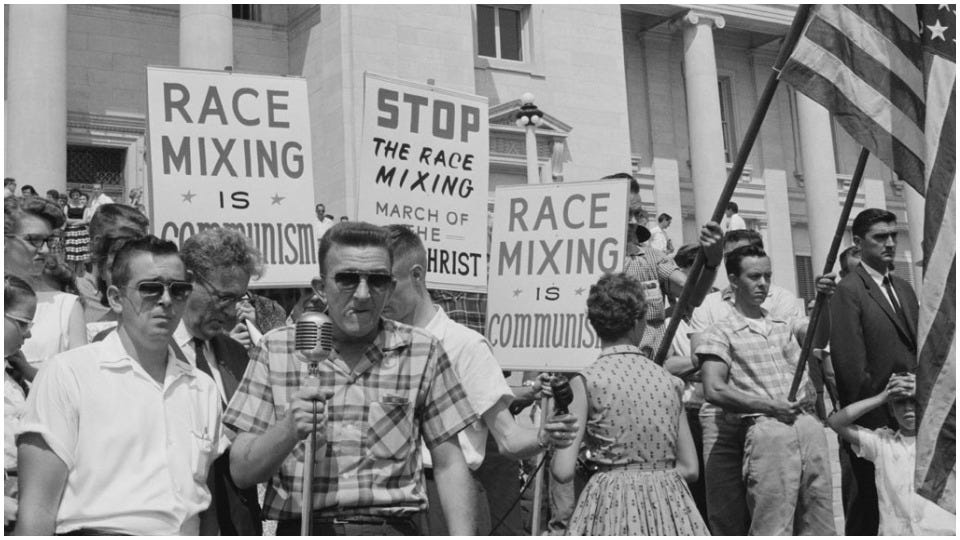
Library of Congress

For the sake of this essay, we’ll describe practice as any thought, feeling, or behavior that is repeated on a regular¹ basis. Intentional practice is, therefore, any intentionally repeated thought, feeling, or behavior. So, for the folks captured in the above photo, let’s assume (despite the dangers therein) that they have intentionally created or purchased the signs they’re holding, and that they have intentionally shown up at this venue to make their views known.

Beyond their chosen signs and location, let’s explore this question: To what extent had they intentionally practiced the thought processes and behaviors that led them to want to stop “race mixing” and equate it with communism? Asked differently, was this view the result of a regular, intentional process of exploration and reflection or just something they chose to repeat because it first had been culturally given to them and then it subsequently reinforced these given biases? What had they practiced that got them to this point?

We can practice just about anything: meditation; strength training; nail-biting; yoga; writing; shooting; mindfulness; foot-tapping; reading; an athletic skill; a musical skill; cooking; checking social media; critical thinking; tai chi; relaxing; compassion; (im)patience; curiosity; public speaking; poor or good posture. You get the idea. Sorry if I omitted your favorite practice.

When we choose to practice — when our repeated thoughts, feelings, and/or behaviors are intentional — it makes sense to say that we practice or we have a practice. When we don’t choose what we practice — when our repeated thoughts, feelings, and/or behaviors are unintentional — it makes sense to say that they practice us — we are practiced by them.

All of us, whether we know it or not, are practiced by something. We regularly are at the effect of thoughts, feelings, and/or behaviors that have chosen us, and with no exceptions, these unintentional practices can serve us, harm us, or both serve and harm us. When they harm us, we often call them addictions, and when we call them addictions we tend to conjure images of injected, inhaled, or swallowed substances. But we can be addicted to daydreaming, foot-tapping, falsehoods, fallacies, and nail-biting as well.

In her book, Getting Our Bodies Back, Christine Caldwell describes addiction as “a consistent physical response to a consistently unmet need” — something we do in order not to be present to what is.² In The Myth of Normal, Gabor Maté describes addiction as “a complex psychological, emotional, physiological, neurobiological, social, and spiritual process [that] manifests through any behavior in which a person finds temporary relief or pleasure and therefore craves, but that in the long term causes them or others negative consequences, and yet the person refuses or is unable to give it up.”³ Addictive behaviors tend to arise when something in the present moment is too painful to bear. Unfortunately, unless that causative “something” is recognized for what it is, addictive behavior continues even after the painful moment(s) has (or have) passed. We continue to try to escape that past painful something.

Caldwell writes that addiction is characterized by 1) repetition; 2) a lack of development — no progress is made; 3) lack of satisfaction — the need is not met; 4) lack of completion; and 5) being uncomfortable to watch. Maté points to three characteristics: 1) short-term relief or pleasure and therefore craving; 2) long-term suffering for oneself or others; and 3) an inability to stop.

To summarize, our addictions are repetitive, arise from an attempt to keep us safe, don’t provide long-term development or relief, do provide long-term suffering, and are difficult to stop.

These traits are consistent with the thoughts, feelings, and behaviors that characterize America’s competing narratives and collective Shadow. We are addicted to thoughts, feelings, and behaviors that keep us and our senses of real or imagined identities intact as we try to avoid what’s true. We don’t progress; we are not satisfied; we occasionally get some short-term relief; we suffer in the long-term; and we don’t seem to be able to stop.

It’s definitely uncomfortable to watch.

_____

  1. “Regular” admittedly is a vague term. For the sake of argument, we’ll say something is a regular practice if it’s engaged at least once a week. That’s quite arbitrary and open to debate since most of what we’re exploring in this essay takes place decidedly more frequently.
  2. Christine Caldwell, Getting Our Bodies Back: Recovery, Healing, and Transformation through Body-Centered Psychotherapy. Boston: Shambhala, 1996 (44–45).
  3. Gabor Maté, with Daniel Maté, The Myth of Normal: Trauma, Illness & Healing in a Toxic Culture. New York: Avery, 2022 (224–25).

Healing America’s Narratives: Resistance: Sources and Resources

[Part of a series, this essay continues our exploration of Healing America’s Narratives: The Feminine, the Masculine, & Our Collective National Shadow. Now available.]

Bear navigating resistance with the suet cage

While we did not explicitly explore resistance in Healing America’s Narratives, it is implicitly present in every chapter of the book — always there any time we bump up against something that challenges our current view or way of doing things. Europeans resisted embracing Africans as equals and instead enslaved them; Europeans resisted embracing the indigenous peoples of what are now known as the Americas and instead lied to them, took their land, and tried to force them to abandon their cultures. Men have resisted embracing women as equals for millennia. You get the idea. There are many more examples, but resistance can lead to good as well.

In my training as a coach with Integral Coaching Canada, we got intimate with resistance in our own lives so we might better work with it when it showed up in a coaching (or any other) relationship. In coaching, both the client and the coach are apt to resist something. Kevin Snorf — a mentor, colleague, and friend — is steadfast in his belief that resistance is necessary for, and is in fact a first step in, progress or development. What follows arises in large part from what I continue to learn from him.

In coaching, we find resistance when coaching is not the appropriate modality for the client (this rarely happens, and when it does, it tends to become evident in consultation — before formal coaching begins). Once coaching begins, resistance may arise for various reasons. Here are three, listed in order from least to most common:

  • The scale of the coaching is not appropriate for the client (usually this means the coach has miscalculated at some level or is projecting something onto the client).
  • The client doesn’t understand or is not convinced of the value of a particular request or practice (usually because the coach has not conveyed the purpose, meaning, or “why” adequately).
  • The client’s current view or “way of being” in the world — how and who the client is at the onset of the coaching — opposes any change to the status quo (changing the status quo in some way is the goal of most coaching, and resistance to change is an expected and “normal” part of the process).

So, translated from the specifics of a coaching relationship and into our ongoing attempt to recognize, own, and integrate Shadow in order to heal an individual or collective narrative, resistance might arise based on:

  • Scale: The depth of the denial and projection (Shadow) and the complexity of the healing that is warranted feel overwhelming, so it’s hard to know how and where to start, and resistance to both the Shadow work and the healing arises. When this happens, finding one accessible, simple step is essential. You can’t eat that entire meal in one bite. Start somewhere, chew thoroughly, swallow and repeat. Monitor your serving size, clean your plate, and don’t overeat.
  • Lack of understand, purpose, or “why”: In our lives (outside the coaching relationship), this one will usually prevent progress. It can stop us cold. In the absence of an understanding of why we might benefit from Shadow work and healing our narratives — without a sense of purpose — the status quo will feel all right, or at least better than trying to change. Communities of practice, professionals, family, or good friends might help us here. (In future essays, we’ll address the importance of practice).
  • The current way or view is getting in the way: We tend to enjoy and welcome what is comfortable, habitual, or familiar. By definition, growth and development move us beyond habit and familiarity, and inevitably involve some discomfort. When it comes to a more flexible body, our muscles initially resist the stretch beyond what’s comfortable; one way toward a stronger body is literally called resistance training — push or pull against the weight. Our minds tend to resist the unfamiliar, and the unfamiliar is how we learn, grow, and develop.

So, if you’re bumping into resistance, don’t fall in love with or attempt to exile it. Rather, pay attention. There’s a message in there somewhere. To paraphrase Rumi in “The Guest House,” be grateful for every unexpected visitor.

_____

More on resistance: Joanne Hunt, “Coaching: The Dance of Change and Resistance. Joanne founded Integral Coaching Canada with Laura Divine (1954–2022). Kevin Snorf and I were both fortunate to have them as teachers. https://www.integralcoachingcanada.com/sites/default/files/pdf/danceofchange.pdf

Healing America’s Narratives: I Am Going To Die

[Part of a series, this essay explores a subheading from Chapter Eleven of Healing America’s Narratives: The Feminine, the Masculine, & Our Collective National Shadow. Now available.]

Photo ©by Philippa Rose-Tite on Unsplash

We’re returning to Chapter Eleven of Healing America’s Narratives after our departures in the previous two posts — the inevitability of the current state of the country and the apparent belief, shared by both Democratic and Republican leadership, that they need never-ending millions of advertising dollars in order to win elections and defeat each other (for the good of the country).

“I am going to die” is the fifth of six statements and questions that frame Chapter Eleven, which explores some approaches to manifesting the book’s title — Healing America’s Narratives. The statement is ‘simply’ an acknowledgment of what is — what’s true — that given enough time, we all die. No one knows how, when, or where, but with each breath we take, we get closer to our final breath.

Our responses to the some of the earlier questions and statements from Chapter Eleven inform how we might respond to this acknowledgment of our mortality. If who we think we are is simply an assembly of flesh, bone, instinct, thought, and mood — nothing but separate animated objects with a few shared traits and some noticeable differences — then the horrors of the histories of womenNative AmericansAfrican Americans, the Vietnam War, the post-9/11 war on terror, and other significant histories, while still horrific, make sense in an ignorant, arrogant, fearful, bigoted, violent kind of way.

If, however, we all share an origin, a common ancestry — whether through a religious or a scientific story — and if we each have a unique ecological niche — our ultimate place in the world, our Soul, expressed through mythopoetic identity as a one-time-only manifestation of Spirit, All That Is, God, Source, Ground of Being — then it becomes a tad more difficult — it makes no sense at all — to proclaim the supremacy of any race, to declare you’re either with us or you’re with the enemy, or to in any way dehumanize others. The stories we choose about who we are, really, make a difference.

Each of us has our own dying and death stories. If we’re lucky we get to bury our parents and older siblings, our grandparents, aunts and uncles, and others from the generations that precede us. Some of these deaths, while sad, are expected and feel natural; sometimes they are unexpected and feel tragic. What is the story each of us tells, what is the story that you choose to tell, about the inevitability of death? As Mary Catherine Bateson told us, “The choice you make affects what you can do next.”¹

The late surgeon and author, Sherwin Nuland, wrote that death results “all too frequently [from] a series of destructive events that involve…the disintegration of the dying person’s humanity,” and that he had not “seen much dignity in the process by which we die.” Nuland, however, complemented his surgeon’s intimacy with the sterility, knowledge, precision, life, and death of the operating room with his philosopher’s view and his poet’s heart. “The greatest dignity to be found in death is the dignity of the life that preceded it,” he told us.²

If you want a dignified death, your best bet is to live a dignified life. If you want a dignified country, your best bet is live, and help others live, a dignified life by coming to terms with things as they are, being the change you want to see in the world, and at the very least, doing more good than harm through your words and actions.

_____

  1. Mary Catherine Bateson, “Composing a Life,” Sacred Stories: A Celebration of the Power of Stories to Transform and Heal. Eds. Charles & Anne Simpkinson, (HarperSanFrancisco, 1993), 42–43.
  2. Sherwin B. Nuland, How We Die, (Knopf, 1993), “all too frequently…,” xvii; “The greatest dignity…,” 242.

Healing

America

Narrative

Healing America’s Narratives: Money, Elections, Democrats, Republicans, & Money

[Part of a series, this essay explores aspects of the idiocy that characterize America’s two-party approach to political campaigns. Healing America’s Narratives: The Feminine, the Masculine, & Our Collective National Shadow. Now available.]

Photo © by Maria Thalassinou on Unsplash

Note: I am an unaffiliated voter — I am a member of neither the Republican nor the Democratic party. I used to be a member of one of them, and am still more generally aligned on most issues with that party. This essay captures the essence of why I dropped my membership with one party and why I would never become a member of the other party.

From October 20, 2022 through the publication of this essay, I received over 500 emails asking me for money in support of candidates for office in states in which I do not live. More than 300 of those emails came after election day, November 8, and specifically asked for money regarding the Georgia Senate runoff. I also received a significant number of snail mail documents — all of which were focused on local elections for the town, state, and national districts in which I actually live.

Between October 21 and November 5, I made four modest (two-figure) contributions to the campaigns of candidates whose positions on most issues I generally agree with. Despite the 300-plus emails that arrived in my inbox after election day, and despite my strong support for one of the two Georgia Senate candidates, I did not contribute to the runoff campaign.

Here’s why, and this is equally applicable to the Democratic and Republican parties and their leadership: if you really believe that the only way you can win and govern is by telling me multiple times a day you need another $250,000 by tonight’s (and tomorrow’s and the next day’s…) deadline — amounts and deadlines that you conjured within a system that you created— and that you’re counting on my $35 or $45 or $75 (which you’re willing to quadruple!!!) in order to outspend the other party’s extensive fundraising; and if you’re going to continue to ask me for money multiple times a day WHETHER OR NOT I MAKE A CONTRIBUTION this time; and if your requests are characterized by BOLD AND CAPS and yellow highlights (which I can’t reproduce here), then you must think I’m an idiot (I’m not, for the most part). Those highlighting tactics are consistent with what used to be used on late-night television commercials for kitchen gadgets, pain-relief gadgets, and OTHER important and REALLY good DEALS! They may still be used, but I don’t stay up late anymore.

Plus, if you can actually quadruple all those modest contributions, why do you need them at all? Just use the cash you already have on hand for quadrupling. The problem is that you (Republican and Democratic leadership) make the case that what’s needed to save the country (from each other) is more money from me and other citizens. You use this money for advertising. You advertise using hyperbole, insult, and distorted photos of your opponents (i.e. each other).

What the hell is wrong with you?

Yes, I understand that you wouldn’t be behaving as you do if you didn’t have research-based evidence that it works on American voters who suffer from civic (and other types of) ignorance.

Here’s one specific example — my views on a letter I received from a candidate in a race to represent me in Congress. The lowlight of this particular letter was the candidate’s (or his handlers’) attempts to associate his opponent with the “defund the police” folks. His opponent’s spouse is a veteran police detective. That’s a rather tame example, but it makes the point.

So again, I ask, what the hell is wrong with you?

Healing America’s Narratives: The Inevitability of the Current Mood of the United States

[Part of a series, this essay explores the inevitability that surfaced amid the research for and writing of Healing America’s Narratives: The Feminine, the Masculine, & Our Collective National Shadow. Now available.]

Photo © by tom coe on Unsplash

If we begin with Jamestown, Virginia in 1607 and work our way forward through each day since then, especially those days not included in some of the more (in)famous years like 1619, 1776, 1787, 1830, 1865, 1868, 1920, 1945, 1964, 2001, 2003 (et cetera)¹ and into our current state of affairs in the third decade of the twenty-first century, where we are as a country is inevitable. Said differently, our ignorance, arrogance, fear, bigotry, violence, greed, excess, bullying, and untrustworthiness are not surprising.

In his Pulitzer Prize-winning A Bright Shining LieNeil Sheehan wrote this about the 1968 My Lai massacre in Vietnam:

“What Calley and others who participated in the massacre did that was different was to kill hundreds of unarmed Vietnamese in two hamlets in a single morning and to kill point-blank with rifles, pistols, and machine guns. Had they killed just as many over a larger area in a longer period of time and killed impersonally with bombs, shells, rockets, white phosphorous, and napalm, they would have been following the normal pattern of American military conduct. The soldier and the junior officer observed the lack of regard his superiors had for the Vietnamese. The value of Vietnamese life was systematically cheapened in his mind…. The military leaders of the United States, and the civilian leaders who permitted the generals to wage war as they did, had made the massacre inevitable.”²

Sheehan’s words indict the worst of leadership that arise through unhealthy masculine energy. Be it military or civilian, local, state, or national, such leadership renders inevitable, or at least highly likely, horrors such as My Lai in 1968; the mutilation and slaughter of Cheyenne men, women, and children at Sand Creek in 1864; the massacre of Lakota men, women, and children at Wounded Knee in 1890; the more than 6,000 lynchings of blacks between 1865 and 1950; the incineration of Tulsa, Oklahoma’s Greenwood district in 1921; the degradations of Abu Ghraib and Guantanamo in the post-9/11 war on terror; and the incessant gun violence in the U.S. Among other examples.

In response to a school shooting at Oxford High School in Michigan, two members of the U.S. House of Representatives³ created Christmas photo cards, posing their families holding assault rifles in front of Christmas trees in 2021 in support of the weapons commonly used in U.S. Congress-enabled mass shootings. Evidently, these folks were channeling the intersection of what Jesus meant when he said “Love one another,”⁴ and what the framers had in mind when they penned the Second Amendment.

That’s a small sample of evidence regarding the inevitability of our current culture of violence. What about greed and excess, you ask? A country built on slave and peasant labor, sweatshops, migrant workers, and now cheap international labor renders inevitable a 2022 second quarter report that the wealthiest 1% of Americans own 31.1% of the nation’s wealth; the top 10% own 68%; and the bottom 50% own 3.2% (the 40% of Americans who fall between the bottom 50% and the top 10% own 28.9%). Said differently, the top 10% of Americans own more than twice (68%) of what the bottom 90% own (32%). This is like saying that the folks in Texas and Montana (together about 10% of the nation’s population) own more than twice as much wealth as the rest of the country. In a nation where owning and having things is important, this is a big deal.

Here’s one more juxtaposition: the defense industry — those companies that build and maintain the weapons and infrastructure of war and everyday violence, and the insurance-pharmaceutical-medical-government-finance-lobbying industry (euphemistically referred to as healthcare in the U.S.) are both for-profit endeavors. Need more deterrence, want to go to war, or choose to keep assault weapons available to our huddled masses? Cha-ching. Need to attend to the physical and psychological effects of war, everyday violence, and active shooter drills for school children? Cha-ching. Need to make sure none of this changes? Have more lobbyists in D.C. (more than 700) than there are members of Congress (currently 535 when all seats are filled).

The above are selected, limited examples, painted with broad brush strokes. For more specific information, see Healing America’s Narratives: The Feminine, the Masculine, & Our Collective National Shadow.

_____

  1. Briefly: 1619 (initial delivery of enslaved Africans to what is now Virginia by the British); 1776 (U.S. Declaration of Independence); 1787 (U.S. Constitution); 1830 (Congress passes “Indian Removal” Act); 1865 (Civil War ends; 13th Amendment passed); 1868 (14th Amendment passed; Second Fort Laramie Treaty); 1920 (19th Amendment passed); 1945 (U.S. drops two atomic bombs on Japan; World War II ends); 1964 (Civil Rights Act passed); 2001 (September 11 terrorist attacks on U.S.); 2003 (U.S. preemptively attacks Iraq).
  2. Neil Sheehan, A Bright Shining Lie: John Paul Vann and America in Vietnam, (New York: Random House, 1988), 689–90.
  3. Lauren Boebert (R-Colorado) and Thomas Massie (R-Kentucky): https://www.nbcnews.com/think/opinion/christmas-card-guns-lauren-boebert-thomas-massie-start-new-culture-ncna1285709
  4. For younger readers: Christmas began as a celebration of the birth of Jesus Christ and had nothing to do with retail sales, garishly decorated real and fake trees, and assault weapons.

Healing America’s Narratives: Who Are My People?

Part of a series, this essay explores a subheading from Chapter Eleven of Healing America’s Narratives: The Feminine, the Masculine, & Our Collective National Shadow. Now available.

Photo © by Brittani Burns on Unsplash

Who Are My People?

In the perfectly integrated, comprehensive, inclusive, and balanced universe in which most of us do not (think we) live, we can hear the mystical cheerleaders’ rhythmic, enthusiastic, and obvious response echoing around the arena: EV-ree-one! Where most of us do think we live, it can be helpful to have a sense of who our people are — not in the unhealthy us-against-the-others sense that governs most finite games, but in the sense of realistically assessing how and with whom I might do the most good in the world as it is, with what I have to offer, without harming others, to the benefit of the whole shebang. Taking care of my, or our, little niche is often the best way to serve the greater good.

Often, the answer to this question lies not in some definitive choice we make but in our authentic attention to the intersections of who we think we are, the stories we choose, the impacts we both have and receive, and what we are able to uncover and own that we previously had not seen. While “my people” may be superficially identified, or at least narrowed down, through blood, geography, and chronology, they are inevitably found and known through experience, belief, and worldview. They include those I learn from and learn with and those who learn from me — whether the learning emerges in the classroom, on the street, at the checkout counter, in the healthcare office, at work, or at the kitchen table. Consider the words of Ta-Nehisi Coates, as his writing led him into “contact with more human beings”:

“I had editors — more teachers — and these were the first white people I’d ever really known on any personal level. They defied my presumptions — they were afraid neither for me nor of me. Instead they saw in my unruly curiosity and softness something that was to be treasured and harnessed.”¹

The friends we choose and who choose us in childhood and adolescence, the groups we align with when we choose a craft, profession, or area of study (or one chooses us), and the individuals in our chosen craft, profession, or discipline towards whom we gravitate may provide insight and evidence about, but don’t necessarily define, “our people.” Many folks will come, stay for a while and go; others will come and stay. We begin to recognize some who stay, and even some who go, as our people.

As tempting as it can be to espouse an all-of-us perspective and claim everyone as our people (as those mystical cheerleaders did above), if we’re operating primarily from a Body-Mind identity, it is difficult to embody and live up to that claim — despite its value and attractiveness. Better to live in a healthy embodiment of who our people truly are right now, than to delude ourselves with an espoused, but not yet embodied and lived, self-aggrandizing claim.

Still, part of our intentional practice might be to “act as if” all humans are our people and to see how such practice impacts our sense of self, our beliefs about others, and our behavior.

_____

  1. Ta-Nehisi Coates, Between the World and Me, (One World-
    Random House, 2015), 62.

Healing America’s Narratives: What Am I Not Seeing?

Part of a series, this essay explores a subheading from Chapter Eleven of Healing America’s Narratives: The Feminine, the Masculine, & Our Collective National Shadow. Now available.

In our previous three inquiries into subheaders from Chapter Eleven, “So, Now What?” we explored identitystory, and impact. Here we’ll consider what any one of us — or millions of us — might be missing with regard to our own lives and/or our country. “Shadow,” as it’s referred to throughout the book, is one reason, among others, an individual or a collective might not be seeing something.

There are various ways to work with Shadow.¹ One hint that an element of Shadow may be clamoring for our attention is if we notice a disproportionate emotional response to someone or something — especially if that response recurs. So, a recurrent, disproportionate, emotional response to someone or something we experience as being angry or lacking in compassion may be inviting us to explore our own anger or lack of compassion. Likewise, if we have such a response to someone or something we experience as exceptionally creative, generous, or successful, we may want to explore our own as-yet disowned creativity, generosity, or success.

Whether what we’re not seeing is considered positive or negative, recognizing, owning, and integrating it into our sense of self leads to a more integrated, “wholer,” fully human being.

Questions such as these may begin to uncover what might be repressed, denied, and projected:

1. What is it about this situation, person, event, issue, idea, emotion, or dream, such that I respond as I do?

2. What is it about me, such that I respond to this situation, person, event, issue, idea, emotion, or dream as I do?

3. To what extent do my reactions or responses feel disproportionate?

4. What might I be projecting onto this situation, person, event, issue, idea, emotion, or dream that I need to explore in myself?

The first question engages through an external locus of control. It helps begin to identify the source of the disproportionate response by looking toward something out there. Getting clearer about what that something is moves us closer to identifying Shadow — what we don’t yet see or know about ourselves.

The second question engages through an internal locus of control and is more challenging. It implicates us. What is it about me such that I respond as I do? Ooh, is my discomfort with his ease in expressing anger related to my unowned anger? Is my admiration for her success in the art world the result of my own as-yet-unrealized creative potential? What is it, exactly, that brings up my disproportionate response? Now, I’m curious. Repressing and projecting parts of ourselves requires energy. Owning and integrating what we repress and project frees up our energy for other aspects of life.

The third question invites us to authentically consider the extent to which our response is disproportionate to the reality of the situation, person, or thing. Honest, challenging, trusted friends may be helpful here.

The fourth question explores the quality, emotion, trait, or characteristic that may be repressed, denied, and projected. Sometimes we recognize it immediately, and perhaps experience a mix of relief, guilt, or simply, oh, THAT! Sometimes it may be slower to emerge — harder to see and even harder to own and integrate. Oh. That. Me? Lacking compassion? Nah. No way. For that one particular colleague/friend/sibling…? Um, perhaps, yes.

Working with Shadow can be discomfiting. Be kind to yourself.

  1. Among many, see Bill Plotkin’s Wild Mind (207–34) and Soulcraft (267–80); and Connie Zweig and Jeremiah Abrams, eds. Meeting the Shadow (65 essays from a variety of authors).

Healing America’s Narratives: What’s My Impact & What Impacts Me?

Part of a series, this essay explores a subheading from Chapter Eleven of Healing America’s Narratives: The Feminine, the Masculine, & Our Collective National Shadow. Now available.

What’s My Impact & What Impacts Me?

What’s my impact — what’s the nature of the wake I’m leaving as I swim, paddle, sail, or otherwise make my way along the river or across the ocean of life? How does my wake impact other vessels and the water itself, and to what extent am I aware of this impact?

What impacts me — what is the nature of the impact on me of other vessels, the wakes they leave, and the river or ocean itself? Less metaphorically, what beliefs, behaviors, habits, cultures, relationships, environments, systems, and people affect me; to what extent, large or small, do they affect me; and what, if anything, am I doing or can I do about it?

With such questions, it helps to explore the broadest, deepest view available of my current beliefs, behaviors, relationships, and environments. Shining the light of awareness on my current awareness — witnessing myself as I am — is a significant practice. What interiors and exteriors impact who and how I am? Whether, when, where, and how I choose to shine this light of awareness emerges from the story I hold (or that holds me) about who I think I am, and the worldview — focused on me, us, all of us, or all that is — that holds my story.

The world of experience continues to offer additional givens throughout our lives. The concrete manifestation of our earliest and ongoing givens are the literal infrastructures and systems — the natural and human-made environments — in which we live our lives, from the tablet, computer, or phone you’re using right now, to the physical space you’re in, to the electricity or to the sun itself that lights that space. Cultural givens and environments co-arise, co-relate, and impact each other and each of us. Beliefs and values lead to things and systems, which in turn revise and create beliefs and values — which in turn lead to new things and systems.

Intentional fire, writing, the wheel, horticulture, agriculture, gunpowder, the printing press, steam power, trains, electricity, internal combustion, the automobile, paved roads, airplanes, the assembly line, the radio, television, space travel, atomic power, computers, robotics, the World Wide Web, smart phones, social media and many other technologies shaped and shape our environment, and, in turn, they shape us. Way back in the previous century, Neal Postman proposed six questions that are worth exploring each time a new technology is being developed or emerges:

1. What is the problem to which this technology is a solution?

2. Whose problem is it?

3. Suppose we solve the problem and solve it decisively, what new problems might be created because we solved the old problem?

4. Which people and what institutions might be most seriously harmed by a technological solution?

5. What changes in language are being enforced by new technologies and what is being gained and lost by such changes?

6. What sort of people and institutions acquire special economical and political power because of technological change?¹

The importance of these types of questions occurs at the intersections of everything is a story, technological impact, and who we think we are. Here are some variations on a theme:

1. How does who you think you are impact what stories you are telling yourself about the impact of the technologies you choose to use or must engage with every day?

2. How do the stories you tell yourself impact who you think you are and the technologies you choose to use or must engage with every day?

3. How do the technologies you choose to use or must engage with every day impact the stories you tell yourself about who you think you are?

The above is not an attempt at cleverness. Consider spending some time with these questions in the context of what you believe is true, first in your own life, and then in the history and current affairs of the United States. Identity, story, and impact matter.

_____

1. Neal Postman, “Staying Sane in a Technological Society: Six Questions in Search of an Answer,” Lapis, (New York Open Center, Issue 7, 1998), 53–57.