The previous posts in this series provide evidence that the problems and mood of the United States of America in the third decade of the twenty-first century are not surprising and are inevitable when history and current events are viewed through a trans-partisan, developmental lens.
A significant number of elected officials, including those I vote for and those I would never vote for, and a significant number of paid performance news commenters either do not know this (ignorance), do know it but avoid telling the truth due either to partisan agendas (arrogance) or to their concerns with not being re-elected or losing their jobs and careers (fear). Ignorance, arrogance, and fear are not mutually exclusive.
Instead, both groups play whack-a-mole.
They never seem to consider the hidden network of mole passages that are below the surface and that allow the moles to appear, avoid the whack, and reappear later through a different hole. The moles escape and reappear through a new hole because the whackers’ views tend to be so far from whole.
Each day, faced with the enormities of the consequences of the violence, depression, suicide, inequality, intolerance, ambivalence about the planet, lack of health and caring, greed, and excess that inform American history and current society, they try to whack a mole a day — or talk about whacking a particular mole. Again, they do not, cannot, or refuse to recognize the existence of the vast underground mole network that makes their whacking so frustrating or the interrelatedness of the various moles (or the same mole) that pop(s) up at different times and places.
Mole-whacking provides the appearance of busy-ness and hard work while very few, if any, moles actually get whacked. More importantly, whacking any particular mole will never get to the foundational, historical elements of the collective American Shadow (ignorance, arrogance, fear, bigotry, violence, greed, excess, bullying, untrustworthiness) that helped build the mole network and that keep it hidden.
These mole-whacking elected officials and paid performance news commenters will continue to whack moles as long as American citizens are willing to encourage, tolerate, or ignore this idiocy. What about you? Are you encouraging, tolerating, or ignoring this mole cruelty?
And yes, there are some elected officials and paid performance news commenters who try to point to the history of mole whacking and the mole network and keep their own whacking activities to a minimum.
Were Sisyphus real, he would probably admire them.
In The Myth of Normal, Dr. Gabor Maté writes that “[t]he meaning of the word ‘trauma,’ in its Greek origin, is ‘wound.’ Whether we realize it or not, it is our woundedness, or how we cope with it, that dictates much of our behavior, shapes our social habits, and informs our ways of thinking about the world.”¹
Dr. Bessel van der Kolk, in The Body Keeps the Score, is clear that “trauma is NOT the story of what happened a long time ago; trauma is residue that’s living inside of you now…in horrible sensations, panic reactions, uptightness, explosions, and impulses.”² He reminds us that trauma is not limited to combat veterans, refugees, or victims of violent crimes or natural disasters. “Trauma happens to us, our friends, our families, and our neighbors,” and it “affects not only those who are directly exposed to it, but also those around them.”³
Individual trauma can result from a one-time event or from exposure to repeated events like ongoing childhood abuse or neglect (known as complex trauma). Collective trauma impacts groups of people (war, slavery, genocide, natural disasters, etc.). Intergenerational (aka historical or transgenerational) trauma is carried forward through generations, biologically, experientially, and psychologically. Secondary trauma arises when one is exposed to the firsthand traumatic experiences of another. These are not mutually exclusive categories.
In varied iterations, trauma informs our national Shadow and is a core aspect of our history.
The subjugation of women still plays out in many ways, just one of which is the unprecedented rates of anxiety, depression, and suicide among our teenage daughters.⁴
The betrayal and slaughter of Native Americans still plays out in disproportionate unemployment, disease, and low life expectancy, especially on reservations.
The kidnapping, enslavement, and lynchings of Africans and African Americans still plays out in disproportionate susceptibility to specific diseases, mass incarceration, and less access to quality health care.
The effects of every war we’ve engaged in still plays out in the primary trauma of our combat veterans, the secondary trauma of their families, the collective trauma they share, and the intergenerational trauma that has been passed down for centuries.
We are all impacted, at varying levels, by our daily rituals of violent crime, our lack of equitable access to affordable health care, increasingly intense and more frequent natural disasters, “active shooter drills” and actual shooters for our school children, employees, shoppers, and others, and the global residuals of the COVID-19 pandemic. The list continues and it is long.
We are not suggesting here that the intergenerational trauma that is passed down to someone whose life seems otherwise okay carries with it the same immediate experience as the primary trauma of a combat veteran, a victim of violent crime or natural disaster, or those who have been abandoned or neglected. We are suggesting that Americans live in a country that remains an experiment, and that the experiment involves ongoing trauma.
We were conceived through the fertilization of ideas that gave voice to some and subjugated others.
We were born through a bloodbath that pitted Brit against Brit on land stolen from indigenous peoples and developed by kidnapped Africans.
We were raised on enslavement, land and property theft, massacre, betrayal, and peasant labor.
We were reborn in an attempt to maintain the experiment through an anything-but-civil bloodbath with ourselves, from which we have yet to fully recover.
And we were reborn yet again as a financial and military superpower as the result of a global bloodbath.
Without honest recognition of and intentional steps toward healing the individual, collective, and intergenerational traumas of America’s conception, birth, and rebirths, our efforts to re-vision⁵ our narratives and integrate our Shadow will be partial at best, and completely ineffective at worst.
Gabor Maté, The Myth of Normal: Trauma, Illness & Healing in a Toxic Culture, (Avery, 2022), 16.
“Re-vision” simply means to “see again” with fresh eyes something we think we’re familiar with. This is consistent with, and deepens the more conventional use of “revision” to mean change.
Most of us who are more or less healthy have no problem extending compassion to — recognizing and engaging with the suffering of — others. Many of us, however, when it comes to our own suffering, struggle to offer compassion to ourselves.
Kristin Neff, in her book, Self-Compassion, writes that compassion “involves the recognition and clear seeing of suffering….feelings of kindness for people who are suffering….[and] recognizing our shared human condition.”¹ Self-compassion, then, asks us to be mindful — so we can recognize and clearly see our own suffering. It asks us to extend kindness towards ourselves so we might help ourselves alleviate our suffering. And it asks us to recognize and remember our shared human condition — our common humanity — which includes, but need not be defined by, pain and suffering.²
Consider for a moment the importance of Scott Peck’s idea of balancing — of disciplining our discipline — so that we might avoid an overly rigid, narrow, and impossible-to-maintain set of standards, and learn to relax into the prospect of not having to be perfect, accepting our full humanity, and accepting ourselves in all our beauty and blemish. This balancing is a manifestation of self-compassion, which means self-compassion can be an essential part of our self-discipline.
So, the next time you find yourself facing pain, suffering, or both, practice self-compassion.³ Any one of these three, in any order, can help. Each of them invites the others:
Slow down and express care and kindness for yourself.
Remember that pain and suffering are part of our common humanity. You’re not in it alone, even if it feels that way sometimes.
Hold whatever comes up — sensations, thoughts, and emotions — in mindful awareness.⁴
The language of pain and suffering can get a bit slippery. For the sake of this post, pain arises from difficult events and circumstances — we break a bone; we lose a loved one; we have a difficult argument, etc. Suffering arises from how we respond to the pain we experience. If we respond to the pain with anger, denial, or blame, we tend to suffer more (similar to the idea of dirty pain. If we respond to our pain with acceptance and understanding, we tend to suffer less (similar to clean pain).
To truly pay attention in this way, some level of healthy self-discipline is required — not the discipline of the angry parent wielding a belt, but the discipline that helps us move forward when things are difficult. In The Road Less Traveled, M. Scott Peck defined discipline as “the basic set of tools we require to solve life’s problems,” and he characterized “these tools [as] techniques of suffering, means by which we experience the pain of problems in such a way as to work through them…learning and growing in the process.”¹ Peck’s toolbox contains four essential tools: delaying gratification, acceptance of responsibility, dedication to truth/reality, and balancing (learning to discipline discipline).² These tools may seem obvious conceptually, but they must be embraced and embodied if we are to benefit from them in this third decade of twenty-first-century America.
Briefly, delaying gratification requires that we engage what is painful before we, and often in order to, experience what’s pleasurable. Do the hard thing first; get it out of the way. Dr. David Schnarch and Dr. Steven Hayer³ use the term clean pain to refer to our ability to delay gratification and move into the pain of difficult circumstances when we know something must be done, even if we’re not sure what it is. Dirty pain is what we encounter when we try to avoid what is necessary, uncomfortable, and uncertain. The clean pain of delaying gratification often leads to learning, growth and healing narratives; the dirty pain of avoidance or denial tends to lead to increased suffering, a lack of resolution, and illness narratives.
Accepting responsibility requires that we honestly own what’s ours — that we accept and engage those problems that are ours to solve. It is at the heart of healing our narratives and owning and integrating Shadow. It requires that we do the difficult work of wisely and compassionately discerning what belongs to us and what belongs to others. It challenges us to be present to and move beyond the harmful belief that either everything, or nothing, is our responsibility.
Individual dedication to truth or reality (used synonymously here) requires that we know what we mean by these words; collective dedication to truth requires that we agree on these meanings or at least honor each other’s meanings. Our working definition for these essays is Parker Palmer’s view that “truth is an eternal conversation about things that matter, conducted with passion and discipline.”⁴ So, truth is an unfolding part of the infinite game; it is a conversation to which all are invited⁵ — not the domain of one individual or group — and it is important and welcomes and requires both deep feeling and healthy rigor.
Finally, balancing invites the disciplining of discipline and avoids obsession, rigidity, and inflexibility. It allows us to take a day off, to rest and recover, to eat the icing (or even dessert) first, to recognize that sometimes good enough — even if that phrase gets caught in the throat or knots the stomach — is more appropriate than best, great, or good.
Another model of discipline that can be useful comes from retired college basketball coach, Bob Knight. Knight also described discipline as having four components: Do what has to be done. Do it when it has to be done. Do it the best you possibly can. Do it that way all the time. I won’t do a point-by-point comparison with Peck’s model. My experience is that each of these models has value in the practice of self-discipline.
Love is also required if we are to truly pay attention, and we’ll explore it in a future post. In the absence of love, there’s a good chance discipline will either be ignored or manifested in unhealthy, punitive, subjugating ways — whether self- or other-directed.
M. Scott Peck, The Road Less Traveled: A New Psychology of Love, Traditional Values, and Spiritual Growth, (Touchstone-Simon & Schuster, 1978), 17–18.
Peck develops each of these in detail on pages 16–78.
Dr. David Schnarch and Dr. Steven Hayer, in Resmaa Menakem, My Grandmother’s Hands: Racialized Trauma and the Pathway to Mending Our Hearts and Bodies, (Central Recovery Press, 2017), 19–20.
Parker J. Palmer, The Courage to Teach: Exploring the Inner Landscape of a Teacher’s Life, (Jossey-Bass, 1998), 104.
The idea that “all” are invited is important, and it needs to be qualified. A more accurate characterization might be “all who are authentically dedicated to truth.” An example: Trump strategist, Steve Bannon, argued that it was the media and not the Democratic party that was the “real opposition” and that “the way to deal with them is to flood the zone with shit” — which Trump, Bannon, and others did quite well. Michael Lewis, “Has Anyone Seen the President?” in Jonathan Rauch, The Constitution of Knowledge: A Defense of Truth, (Brookings Institution, 2021), 163.
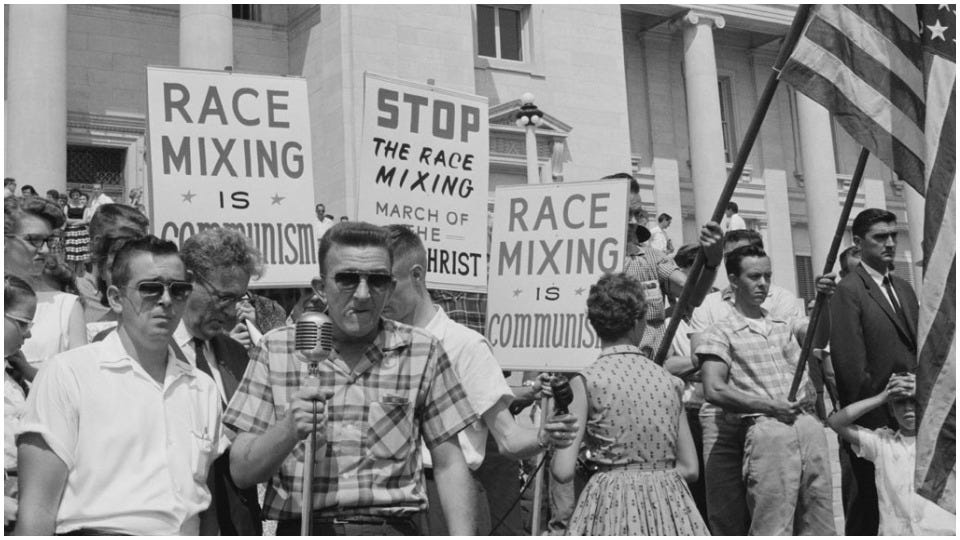
For the sake of this essay, we’ll describe practice as any thought, feeling, or behavior that is repeated on a regular¹ basis. Intentional practice is, therefore, any intentionally repeated thought, feeling, or behavior. So, for the folks captured in the above photo, let’s assume (despite the dangers therein) that they have intentionally created or purchased the signs they’re holding, and that they have intentionally shown up at this venue to make their views known.
Beyond their chosen signs and location, let’s explore this question: To what extent had they intentionally practiced the thought processes and behaviors that led them to want to stop “race mixing” and equate it with communism? Asked differently, was this view the result of a regular, intentional process of exploration and reflection or just something they chose to repeat because it first had been culturally given to them and then it subsequently reinforced these given biases? What had they practiced that got them to this point?
We can practice just about anything: meditation; strength training; nail-biting; yoga; writing; shooting; mindfulness; foot-tapping; reading; an athletic skill; a musical skill; cooking; checking social media; critical thinking; tai chi; relaxing; compassion; (im)patience; curiosity; public speaking; poor or good posture. You get the idea. Sorry if I omitted your favorite practice.
When we choose to practice — when our repeated thoughts, feelings, and/or behaviors are intentional — it makes sense to say that we practice or we have a practice. When we don’t choose what we practice — when our repeated thoughts, feelings, and/or behaviors are unintentional — it makes sense to say that they practice us — we are practiced by them.
All of us, whether we know it or not, are practiced by something. We regularly are at the effect of thoughts, feelings, and/or behaviors that have chosen us, and with no exceptions, these unintentional practices can serve us, harm us, or both serve and harm us. When they harm us, we often call them addictions, and when we call them addictions we tend to conjure images of injected, inhaled, or swallowed substances. But we can be addicted to daydreaming, foot-tapping, falsehoods, fallacies, and nail-biting as well.
In her book, Getting Our Bodies Back, Christine Caldwell describes addiction as “a consistent physical response to a consistently unmet need” — something we do in order not to be present to what is.² In The Myth of Normal, Gabor Maté describes addiction as “a complex psychological, emotional, physiological, neurobiological, social, and spiritual process [that] manifests through any behavior in which a person finds temporary relief or pleasure and therefore craves, but that in the long term causes them or others negative consequences, and yet the person refuses or is unable to give it up.”³ Addictive behaviors tend to arise when something in the present moment is too painful to bear. Unfortunately, unless that causative “something” is recognized for what it is, addictive behavior continues even after the painful moment(s) has (or have) passed. We continue to try to escape that past painful something.
Caldwell writes that addiction is characterized by 1) repetition; 2) a lack of development — no progress is made; 3) lack of satisfaction — the need is not met; 4) lack of completion; and 5) being uncomfortable to watch. Maté points to three characteristics: 1) short-term relief or pleasure and therefore craving; 2) long-term suffering for oneself or others; and 3) an inability to stop.
To summarize, our addictions are repetitive, arise from an attempt to keep us safe, don’t provide long-term development or relief, do provide long-term suffering, and are difficult to stop.
These traits are consistent with the thoughts, feelings, and behaviors that characterize America’s competing narratives and collective Shadow. We are addicted to thoughts, feelings, and behaviors that keep us and our senses of real or imagined identities intact as we try to avoid what’s true. We don’t progress; we are not satisfied; we occasionally get some short-term relief; we suffer in the long-term; and we don’t seem to be able to stop.
It’s definitely uncomfortable to watch.
_____
“Regular” admittedly is a vague term. For the sake of argument, we’ll say something is a regular practice if it’s engaged at least once a week. That’s quite arbitrary and open to debate since most of what we’re exploring in this essay takes place decidedly more frequently.
Christine Caldwell, Getting Our Bodies Back: Recovery, Healing, and Transformation through Body-Centered Psychotherapy. Boston: Shambhala, 1996 (44–45).
Gabor Maté, with Daniel Maté, The Myth of Normal: Trauma, Illness & Healing in a Toxic Culture. New York: Avery, 2022 (224–25).
While we did not explicitly explore resistance in Healing America’s Narratives, it is implicitly present in every chapter of the book — always there any time we bump up against something that challenges our current view or way of doing things. Europeans resisted embracing Africans as equals and instead enslaved them; Europeans resisted embracing the indigenous peoples of what are now known as the Americas and instead lied to them, took their land, and tried to force them to abandon their cultures. Men have resisted embracing women as equals for millennia. You get the idea. There are many more examples, but resistance can lead to good as well.
In my training as a coach with Integral Coaching Canada, we got intimate with resistance in our own lives so we might better work with it when it showed up in a coaching (or any other) relationship. In coaching, both the client and the coach are apt to resist something. Kevin Snorf — a mentor, colleague, and friend — is steadfast in his belief that resistance is necessary for, and is in fact a first step in, progress or development. What follows arises in large part from what I continue to learn from him.
In coaching, we find resistance when coaching is not the appropriate modality for the client (this rarely happens, and when it does, it tends to become evident in consultation — before formal coaching begins). Once coaching begins, resistance may arise for various reasons. Here are three, listed in order from least to most common:
The scale of the coaching is not appropriate for the client (usually this means the coach has miscalculated at some level or is projecting something onto the client).
The client doesn’t understand or is not convinced of the value of a particular request or practice (usually because the coach has not conveyed the purpose, meaning, or “why” adequately).
The client’s current view or “way of being” in the world — how and who the client is at the onset of the coaching — opposes any change to the status quo (changing the status quo in some way is the goal of most coaching, and resistance to change is an expected and “normal” part of the process).
So, translated from the specifics of a coaching relationship and into our ongoing attempt to recognize, own, and integrate Shadow in order to heal an individual or collective narrative, resistance might arise based on:
Scale: The depth of the denial and projection (Shadow) and the complexity of the healing that is warranted feel overwhelming, so it’s hard to know how and where to start, and resistance to both the Shadow work and the healing arises. When this happens, finding one accessible, simple step is essential. You can’t eat that entire meal in one bite. Start somewhere, chew thoroughly, swallow and repeat. Monitor your serving size, clean your plate, and don’t overeat.
Lack of understand, purpose, or “why”: In our lives (outside the coaching relationship), this one will usually prevent progress. It can stop us cold. In the absence of an understanding of why we might benefit from Shadow work and healing our narratives — without a sense of purpose — the status quo will feel all right, or at least better than trying to change. Communities of practice, professionals, family, or good friends might help us here. (In future essays, we’ll address the importance of practice).
The current way or view is getting in the way: We tend to enjoy and welcome what is comfortable, habitual, or familiar. By definition, growth and development move us beyond habit and familiarity, and inevitably involve some discomfort. When it comes to a more flexible body, our muscles initially resist the stretch beyond what’s comfortable; one way toward a stronger body is literally called resistance training — push or pull against the weight. Our minds tend to resist the unfamiliar, and the unfamiliar is how we learn, grow, and develop.
So, if you’re bumping into resistance, don’t fall in love with or attempt to exile it. Rather, pay attention. There’s a message in there somewhere. To paraphrase Rumi in “The Guest House,” be grateful for every unexpected visitor.
In “The Transformation of Silence into Language and Action,” Audre Lorde wrote that “I was going to die, if not sooner then later, whether or not I had ever spoken myself. My silences had not protected me. Your silence will not protect you.”¹ Millions of voices have been silenced over hundreds of years by America’s narratives and collective Shadow. Yet, the mystical branch of every wisdom tradition and the deepening evidence of true science are increasingly clear that silence — becoming aware of, working with, and quieting our incessant mind chatter, and regularly retreating from the noise of our human-made infrastructure — is good for us and allows us to hear, see and feel more deeply. Each is true and necessary. Preventing the external silencing of any voice and encouraging and choosing the intentional silencing of our interior and exterior noise are necessary for individual and societal health.
The United States’ external attempts to silence others is clear whether we look at the histories of women, Native Americans, and African Americans, or the attempts to impose our will and way of life on the people of Vietnam, Afghanistan and Iraq, among others. Despite formal statements regarding the freedoms of speech, the press, and assembly, also known as the First Amendment to the U.S. Constitution, both formal and informal behavior and the nature of many of our systems and institutions at worst limit or deny these freedoms and at best make them inconvenient for selected people at specific times and in specific places. Revisit the links at the beginning of this paragraph for some examples.
On the other hand, the prospect of intentionally choosing silence (and its sibling, stillness) remains and may be becoming increasingly counter-culture, in cities for sure, but even in rural and suburban areas — anywhere people choose to be at the mercy of phones and apps, and yes, that includes the apps that invite us to engage stillness, silence, and meditation. Try the following suggestion the next time you eat a meal or snack alone in a quiet space (if it’s rare for you to eat in a quiet, private place, perhaps give yourself a brief opportunity to try this). It’s especially effective if what you’re eating is crunchy and requires robust chewing.
About halfway through a mouthful, simply stop chewing, and sit with the stillness and silence that remain for 10–15 seconds (or longer). Perhaps close your eyes. Simply notice how this feels, then begin chewing again. Stopping virtually any activity for a brief time period may bring you a similar experience.
Because of the expectations, speed, and noise that are common in American culture, getting still and silent may feel uncomfortable because of the apparent rewards for getting things done, getting them done quickly, and letting others know you got it done. Less apparent, research-based rewards for practicing stillness and silence, however, can positively impact blood pressure, heart rate, muscular tension, and the ability to focus attention (see resources below).
Your homework:
Notice and speak out against the inappropriate silencing of others.
Give yourself the gift of practicing silence and stillness every day — even for just a few minutes.
_____
Audre Lorde, “The Transformation of Silence into Language and Action,” Sister Outsider, (Crossing Press, 1984), 41; and The Cancer Journals, (Penguin, 2020/1980), 13. The essay appears in both volumes.
Some resources (among many) regarding the benefits of intentional silence:
Our exploration of this question in forthcoming essays will necessarily revisit some concepts and practices that we’ve already acknowledged (cultural givens, skillful means, healthy development, intentional practice, silence, openness, truth, and love) as well as some that we have not explicitly addressed, such as resistance, trauma, self-discipline, self-compassion, empathy, and community.
In preparation for what’s to come, as you read this now, consider the previous paragraph and get a sense of — perhaps write down — one or two (or more) of the concepts and practices listed that you feel you would like to work or play with and develop further, and one or two that you feel you are in a good place with — that don’t need your immediate attention. Feel free to add your own if there’s something in your awareness that’s not listed above. And you can always change your mind and revise your list.
Another way to do this, which I find more challenging, is to prioritize the list: #1 would be what you feel you’d most like to work or play with and the final item you list would be what you feel is in pretty good shape right now. Again, none of this is etched in stone; just playing with the list might bring an insight. Stay open and curious.
In an earlier essay, we considered six questions and statements that are important for the healing process. Here they are again, with the first five linked to a brief overview:
How am I in relationship with each of the above questions and statements — and the rest of my life?
We’re focusing on that final question here. Another way to ask the question is “What is the nature of my relationship with…” who I think I am or whether or not everything is a story or what I might not be seeing. Underlying the importance of relationship is the context of healing, which, as we discussed earlier, begins with coming to terms with things as they are. More to the point, when something happens — whether it is expected or unexpected, or considered “good” or “bad” — how we relate to it is as important as — perhaps more important than — the thing that has happened. What is my relationship with the positive or negative test result, the new job or job loss, the argument with my friend, the election result, the stubbed toe, the spilt milk?
This is nothing new. Teachings on our relationships with our minds, events, and stories have been around for millennia:
“It is true that the mind is restless and difficult to control, but it can be conquered… through regular practice and detachment” (6.35) — The Bhagavad Gita, c. 500–200 BCE.
“What really frightens and dismays us is not external events themselves, but the way in which we think about them. It is not things that disturb us, but our interpretation of their significance.” — Epictetus, The Enchiridion¸ c. 0–200 CE.
“No one finds it easy to accept the lot Fortune has sent him….So nothing is miserable except when you think it so, and vice versa, all luck is good luck to the man who bears it with equanimity.” (II.iv) — Boethius, The Consolation of Philosophy, c. 522–524 CE.
“Be grateful for whoever comes, / because each has been sent / as a guide from beyond.” — Rumi, from “The Guest House,” c. 1240–1260, CE, trans. Coleman Barks.
“[E]verything can be taken from a man but one thing: the last of the human freedoms — to choose one’s attitude in any given set of circumstances, to choose one’s own way.” — Victor Frankl,Man’s Search for Meaning.
“The question we should be asking is not ‘Why did this happen to me? What did I do to deserve this?’…. A better question would be ‘Now that this has happened to me, what am I going to do about it?’” — Harold S. Kushner, When Bad Things Happen to Good People.
“I want to … encourage you to think about the creative responsibility involved in the fact that there are different ways to tell your stories. It’s not that one is true and another is not true. It’s a matter of emphasis and context….The choice you make affects what you can do next.…what I want to emphasize are the advantages of choosing a particular interpretation at a particular point in time, and the even greater advantage of using multiple interpretations.” — Mary Catherine Bateson,“Composing a Life.”
“I don’t mean to say that my diagnosis makes me special. Life, as I’ve said before, is a terminal condition. Those of us with terminal illnesses simply have been blessed — and I mean blessed — with having the facts of our own mortality held constantly before us.” — Philip Simmons,Learning to Fall: The Blessings of an Imperfect Life
“Even more astonishing was the realization that, as sick as I was at that moment and as preoccupied as I was about the task awaiting me in less than ten minutes, there was still some kindness, serenity, and compassion inside me to send to others on the out-breath….[Tonglen] took me out of my small world.” — Toni Bernhard, How to Be Sick: A Buddhist-Inspired Guide for the Chronically Ill and Their Caregivers
“Expressive writing is a self-reflective tool with tremendous power. By exploring emotional upheavals in our lives, we are forced to look inward and examine who we are. This occasional self-examination can serve as a life-course correction.” — James W. Pennebaker and John F. Evans, Expressive Writing: Words that Heal
Indeed, our relationships with what we perceive as triumphs, disasters, successes, and failures determine and are determined by the stories we choose to tell about our lives. What stories are you telling such that your relationships are as they are? How might your relationships (and you) shift if you revised your stories? _____
Bateson, Mary Catherine. “Composing a Life.” Sacred Stories: A Celebration of the Power of Stories to Transform and Heal. Eds. Charles & Anne Simpkinson. San Francisco: HarperSanFrancisco, 1993. (42- 48).
Bernhard, Toni. How to Be Sick: A Buddhist-Inspired Guide for the Chronically Ill and Their Caregivers. Somerville, MA: Wisdom, 2010. (99).
Boethius. The Consolation of Philosophy. Trans. V.E. Watts. New York: Penguin, 1969. (63).
“I am going to die” is the fifth of six statements and questions that frame Chapter Eleven, which explores some approaches to manifesting the book’s title — Healing America’s Narratives. The statement is ‘simply’ an acknowledgment of what is — what’s true — that given enough time, we all die. No one knows how, when, or where, but with each breath we take, we get closer to our final breath.
Our responses to the some of the earlier questions and statements from Chapter Eleven inform how we might respond to this acknowledgment of our mortality. If who we think we are is simply an assembly of flesh, bone, instinct, thought, and mood — nothing but separate animated objects with a few shared traits and some noticeable differences — then the horrors of the histories of women, Native Americans, African Americans, the Vietnam War, the post-9/11 war on terror, and other significant histories, while still horrific, make sense in an ignorant, arrogant, fearful, bigoted, violent kind of way.
If, however, we all share an origin, a common ancestry — whether through a religious or a scientific story — and if we each have a unique ecological niche — our ultimate place in the world, our Soul, expressed through mythopoetic identity as a one-time-only manifestation of Spirit, All That Is, God, Source, Ground of Being — then it becomes a tad more difficult — it makes no sense at all — to proclaim the supremacy of any race, to declare you’re either with us or you’re with the enemy, or to in any way dehumanize others. The stories we choose about who we are, really, make a difference.
Each of us has our own dying and death stories. If we’re lucky we get to bury our parents and older siblings, our grandparents, aunts and uncles, and others from the generations that precede us. Some of these deaths, while sad, are expected and feel natural; sometimes they are unexpected and feel tragic. What is the story each of us tells, what is the story that you choose to tell, about the inevitability of death? As Mary Catherine Bateson told us, “The choice you make affects what you can do next.”¹
The late surgeon and author, Sherwin Nuland, wrote that death results “all too frequently [from] a series of destructive events that involve…the disintegration of the dying person’s humanity,” and that he had not “seen much dignity in the process by which we die.” Nuland, however, complemented his surgeon’s intimacy with the sterility, knowledge, precision, life, and death of the operating room with his philosopher’s view and his poet’s heart. “The greatest dignity to be found in death is the dignity of the life that preceded it,” he told us.²
If you want a dignified death, your best bet is to live a dignified life. If you want a dignified country, your best bet is live, and help others live, a dignified life by coming to terms with things as they are, being the change you want to see in the world, and at the very least, doing more good than harm through your words and actions.
_____
Mary Catherine Bateson, “Composing a Life,” Sacred Stories: A Celebration of the Power of Stories to Transform and Heal. Eds. Charles & Anne Simpkinson, (HarperSanFrancisco, 1993), 42–43.
Sherwin B. Nuland, How We Die, (Knopf, 1993), “all too frequently…,” xvii; “The greatest dignity…,” 242.










 Reggie Marra, MA, PCC