Healing America’s Narratives: The Race for Violence — 2023

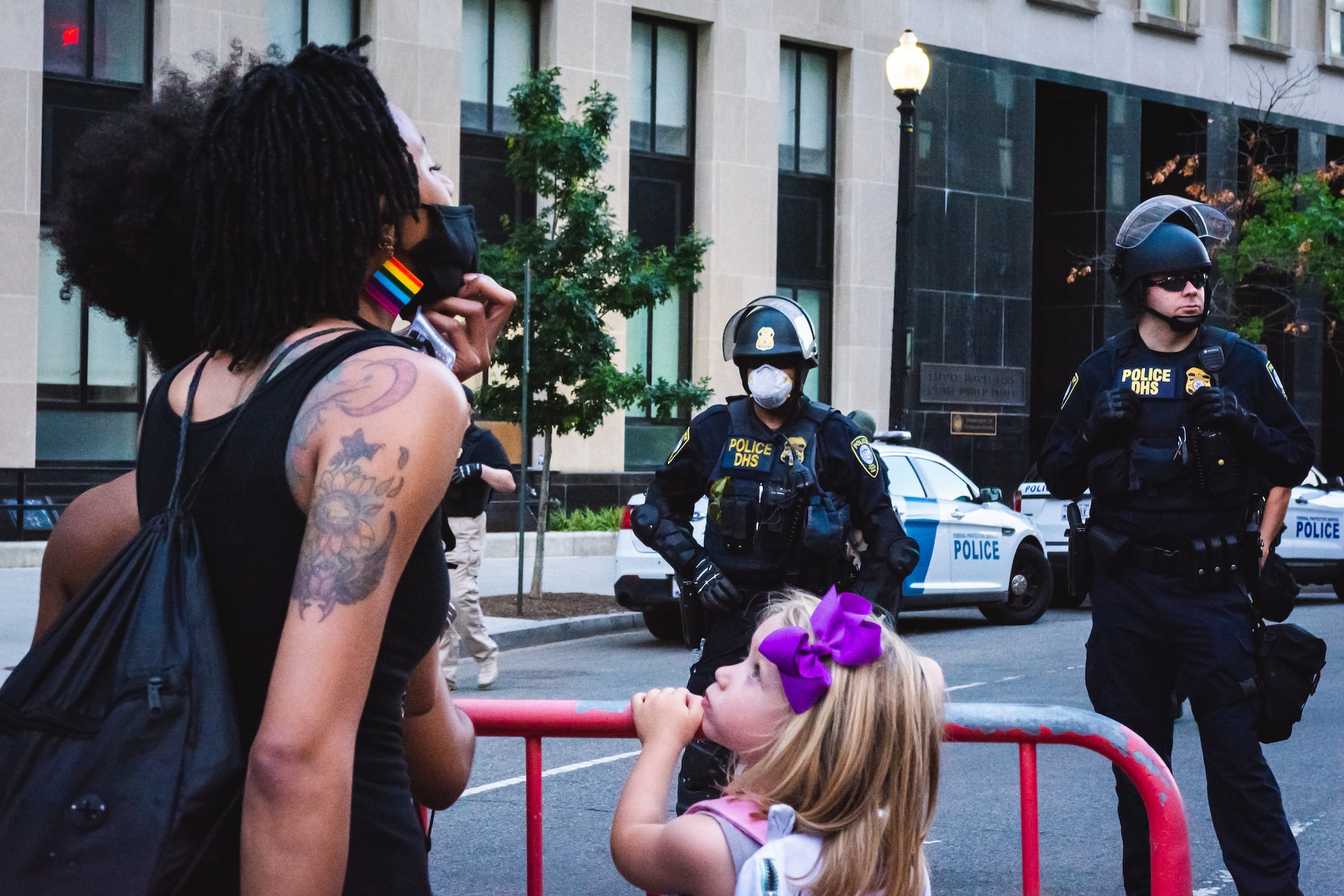
Photo © by Gayatri Malhotra on Unsplash

[Part of a series, this essay looks at some current events in the context of Healing America’s Narratives: the Feminine, the Masculine, & Our Collective National Shadow — Now available]

The context of each of these “Healing America’s Narratives” posts is the collective national Shadow of the United States, as explored in detail in the book by that name. Briefly, America’s collective Shadow carries at least nine traits: ignorance, arrogance, fear, bigotry, violence, greed, excess, bullying, and untrustworthiness.

These nine traits can be observed throughout history, beginning with America’s three foundational subjugations — of womenNative Americans, and African Americans — and continuing up to the present day with the Vietnam Warpost-9/11 wars in Afghanistan and Iraq, expanding inequality, the power of the insurance-pharmaceutical-medical-government-financial-lobbying industry (IPMGFL), patho-adolescent political polarizations, equal opportunity “otherings” of those “we” feel are not enough like “us,” and ambivalence about the planet — which may ultimately render all the other issues moot.

Today’s post focuses on the intersection of three stories that have emerged in March and April 2023:

  1. The shooting in Kansas City, Missouri of 16-year-old Ralph Yarl, by 84-year-old Andrew D. Lester: According to the Washington PostYarl mistakenly rang the doorbell on the wrong house in an attempt to pick up his siblings, who were visiting a friend. Lester, who is white, who is described as being “visibly upset” and “concerned for” Yarl, and who is being charged, claims to have been “scared to death” when he saw Yarl at his door. Yarl, who is black, was shot twice and is now recovering.
  2. The shooting death in Hebron, New York of 20-year-old Kaylin Gillis by 65-year-old Kevin Monahan. According to the Washington Post, Gillis and her friends accidentally pulled into the wrong driveway while they were looking for a friend’s house. Gillis and her friends never got out of their vehicle and were shot by Monahan from his porch while they were backing out of the driveway. As I post this, Monahan, unlike Lester, has expressed no remorse for his action.
  3. According to the Washington PostOklahoma Governor Kevin Stitt called for the resignation of four McCurtain County officials, “county commissioner Mark Jennings, Sheriff Kevin Clardy, sheriff’s investigator Alicia Manning and county jail administrator Larry Hendrix,” who, while speaking after a public meeting without realizing a reporter’s recorder was still on, “lamented about how they could no longer yank Black people out of the jail, ‘take them down to Mud Creek and hang them up with a … rope,’ according to McCurtain Gazette-News, which later published a recording online.”

To keep this simple(ish), we’ll focus on violence, guns, and race — each of which plays a direct role in two of these three stories.

Much of the media- and lobbyist-generated rhetoric concerning the two shootings has been on “stand your ground” and “castle doctrine” laws, which does need attention and is fine as far as it goes, albeit in a superficial, ignore-both-the-details-and-the-larger-context kind of way.

Here are some details: Kaylin Gillis was shot and killed because the car she was in mistakenly turned into the wrong driveway. Remember the days of sorry to bother you — we’re lost — can you direct us towards… Ralph Yarl was shot because he mistakenly rang the wrong doorbell — thinking it belonged to his siblings’ friends. Remember the days of hi, I’m here to pick up my brother — oh, sorry, wrong address…can you tell me where… Kaylin Gillis is dead and her family and friends will live with the trauma of her death forever. Ralph Yarl and his family and friends will live with the trauma of his shooting forever — as will, it seems, his shooter.

Here’s a larger context: Everyday violence, including, but not limited to, gun violence is America’s normal.¹ Ring the wrong doorbell, pull into the wrong driveway, walk home, go shopping, go to your place of worship, go to school, go dancing, go to a concert, go to work. Risk getting shot.

That’s the guns and violence piece.

I’m a five-foot, six-inch, white-bearded, bald-headed, Italian American. Some would reduce me to being an old white guy, but Ta-Nehisi Coates and I know better. Had I mistakenly rang Andrew Lester’s doorbell, do you think he would have shot me? While I can’t know for sure, I’m pretty sure he would not have. Next question: was it Ralph Yarl’s youth, his height, or his skin pigmentation that most scared Andrew Lester? Some well intentioned folks might actually debate that — with obviously he shot because Yarl was black on one side and because of his age, he might have shot any tall, young stranger who appeared at his door on the other. Enjoy that debate.

Here’s the question we need to explore: what is it about the United States of America, and about the specific lives of Andrew Lester, Mark Jennings, Kevin Clardy, Alicia Manning, Larry Hendrix (and “others like them”)such that Lester would shoot a young, black stranger at his door, and that Jennings, Clardy, Manning, and Hendrix would find it appropriate to share or find meaning in their racist, violent imaginings — especially in the context of their roles in local government?

We need to own our individual and collective Shadows. Land of the free? Home of the brave? A beacon of democracy? Peace loving? Toward a more perfect union? Each of these can be true, especially if followed up with a sincere question and exploration: For whom?

_____

¹A small sample regarding America’s normal: 2014-2019: 14,515 gun deaths/year avg. (not suicide) = 40/day avg; 23,094 suicides by gun = 63/day; 37,609 total annual gun deaths = 103/day: https://www.gunviolencearchive.org/ 2014–2019: 45,835 suicides/year avg. = 126*/day: https://webappa.cdc.gov/sasweb/ncipc/leadcause.html Accessed September 28, 2021. Search criteria was: 2014–2019 / all causes, races, genders and ages. *Due to rounding, the suicides per day on the two sites differ by 1. I used the lower, 125, in the text.

Neil MacFarquhar, “Murders Spiked in 2020 in Cities Across the United States,” New York Times, September 27, 2021,https://www.nytimes.com/2021/09/27/us/fbi-murders-2020-cities.html

Reis Thebault and Danielle Rindler, “Shootings never stopped during the pandemic: 2020 was the deadliest gun violence year in decades,” Washington Post, March 23, 2021, https://www.washingtonpost.com/nation/2021/03/23/2020-shootings/ Accessed September 28, 2021. Gun violence ties directly to the unhealthy masculine: Mike McIntire, Glenn Thrush and Eric Lipton, “Gun Sellers’ Message to Americans: Man Up,” New York Times, June 18, 2022, https://www.nytimes.com/2022/06/18/us/firearm-gun-sales.html

Healing America’s Narratives: Thank You, Tennessee

Photo © by Joshua Hoehne on Unsplash

[Part of our ongoing exploration of Healing America’s Narratives: The Feminine, the Masculine, & Our Collective National Shadow, this essay focuses on a school shooting in Nashville and related events in the Tennessee State Legislature that highlight our need for healing. The book is available here.]

On March 27, 2023 a man with a gun killed three adults and three children at the Covenant School in Nashville, Tennessee. School shootings — and shootings in general — are, as you know, a regular part of the American landscape.

On April 7, the Tennessee State Legislature voted to remove two of the three legislators who had participated in a March 30 protest at the Tennessee Capitol calling for stricter gun legislation. The two ousted legislators were Justin Jones, 27, and Justin Pearson, 29 — both of whom are black. The third lawmaker, Gloria Johnson, 60, is white.

When asked why she thought she was not removed as were Jones and Pearson, Johnson replied, “I’ll answer your question — it might have to do with the color of our skin.”

As I write this piece on the morning of April 12, Representative Jones was reinstated after the Metropolitan Nashville Council unanimously voted to temporarily appoint him until a special election is held later this year. The Shelby County Board of Commissioners in Memphis was set to consider reappointing Representative Pearson in a meeting at 1:30pm CT on April 12 (today).

The Covenant School shooting and the removal of two young black men from the Tennessee House for protesting in favor of taking action that might limit gun violence lies at the intersection of two of the issues explored in Healing America’s Narratives — our culture of violence and the enslavement and subsequent subjugation of and discrimination against blacks.

No one, anywhere — at least no one I’ve encountered — wants the next inevitable shooting — whether at a school, a dance club, a movie theater, a bank, a concert, a store, a post office, or a place of worship. Yet, enough local, state, and national elected public servants, many of whom count on NRA and gun manufacturers’ and their PACs’ campaign donations, continue to thwart attempts to ban assault weapons, among other gun-safety measures.

America’s collective national Shadow remains grounded in ignorance, arrogance, fear, bigotry, violence, greed, excess, bullying, and untrustworthiness. Ignorance, arrogance, and greed allow lawmakers to prioritize campaign funding over the health and safety of their constituents. Ignorance, arrogance, fear, bigotry, and bullying convinced two-thirds of the predominantly white, Republican Tennessee House of Representatives to remove two black Democratic lawmakers — albeit temporarily.

This is not an indictment of the people of Tennessee. Obviously, many in the state disagree with their elected officials’ ousting Representatives Jones and Pearson.

Still, thank you, Tennessee, for this particular reminder — along with many other daily reminders from states both Red and Blue — of the work we have to do as a nation.

_____

Who are the Tennessee Three? Here’s what to know.

The Republican-led Tennessee House of Representatives voted Thursday to expel two Democratic lawmakers, Reps. Justin…

www.washingtonpost.com

Healing America’s Narratives: Guns, Money, & Violence

[Part of our ongoing exploration Healing America’s Narratives: The Feminine, the Masculine, & Our Collective National Shadow, this essay focuses on the roles violence and greed play in our collective Shadow. The book is available here.]

Tee shirt photo taken by the author.

The underlying premise in Healing America’s Narratives is that the United States we know in the third decade of the 21st century is inevitable. Viewed through the lenses of history and psychology, our violence, anxiety, depression, addiction, wealth disparity, bigotry, greed, excess, and our individual and collective trauma are anything but surprising.

America remains an experiment:

“We were conceived through the fertilization of ideas that gave voice to some and subjugated others. We were born through a bloodbath that pitted Brit against Brit on land stolen from indigenous peoples and developed by kidnapped Africans. We were raised on enslavement, land and property theft, massacre, betrayal, and peasant labor. We were reborn in an attempt to maintain the experiment through an anything-but-civil bloodbath with ourselves, from which we have yet to fully recover. And we were reborn yet again as a financial and military superpower as the result of a global bloodbath.

“We regularly perpetrate and perpetuate violence against others while refusing to acknowledge and address in any effective way the everyday violence we commit against ourselves…. Not yet 250 years old, we’re lost in a national adolescence, thinking we’re invincible and immortal — despite clear evidence that we are neither. Not only have we not recovered from our bloodbaths of birth and rebirth in any whole, integrated sense, we continue to choose to bathe ourselves and others in blood, literally and metaphorically, because that is the normal we know.”¹

Killing each other with guns is part of a larger legacy.

An online search today for “mass shootings in the US” returned 34,800,000 results in 0.38 seconds. A similar search, for “shootings in the US,” took more time — 0.51 seconds — and returned 2,400,000,000 results. Let’s say those numbers out loud: thirty-four million, eight hundred thousand, and two billion, four hundred million.

We are divided in our views of guns, and we debate interpretations of the Second Amendment while we kill each other and gun sales make a lot of money for a few people. All of our children, in every school district in the country practice active shooter drills. Just in case.

I don’t pretend to have solution to this problem. But as long as there is a moat filled with lobbyists around the Capitol and the protected royalty within need to fund their reelection campaigns, we will continue to sling meaningless slogans and talking points about what the founders wanted, good guys with guns, thoughts and prayers, this has to stop, not one more, and the greatest country in the world. At what?

At violence? Perhaps, yes.

_____

  1. Healing America’s Narratives, 325–26.

Healing America’s Narratives: Trauma

[Part of a series, this essay continues our exploration of Healing America’s Narratives: The Feminine, the Masculine, & Our Collective National Shadow. Now available.]

Photo by Stormseeker on Unsplash

In The Myth of Normal, Dr. Gabor Maté writes that “[t]he meaning of the word ‘trauma,’ in its Greek origin, is ‘wound.’ Whether we realize it or not, it is our woundedness, or how we cope with it, that dictates much of our behavior, shapes our social habits, and informs our ways of thinking about the world.”¹

Dr. Bessel van der Kolk, in The Body Keeps the Score, is clear that “trauma is NOT the story of what happened a long time ago; trauma is residue that’s living inside of you now…in horrible sensations, panic reactions, uptightness, explosions, and impulses.”² He reminds us that trauma is not limited to combat veterans, refugees, or victims of violent crimes or natural disasters. “Trauma happens to us, our friends, our families, and our neighbors,” and it “affects not only those who are directly exposed to it, but also those around them.”³

Individual trauma can result from a one-time event or from exposure to repeated events like ongoing childhood abuse or neglect (known as complex trauma). Collective trauma impacts groups of people (war, slavery, genocide, natural disasters, etc.). Intergenerational (aka historical or transgenerational) trauma is carried forward through generations, biologically, experientially, and psychologically. Secondary trauma arises when one is exposed to the firsthand traumatic experiences of another. These are not mutually exclusive categories.

In varied iterations, trauma informs our national Shadow and is a core aspect of our history.

The subjugation of women still plays out in many ways, just one of which is the unprecedented rates of anxiety, depression, and suicide among our teenage daughters.⁴

The betrayal and slaughter of Native Americans still plays out in disproportionate unemployment, disease, and low life expectancy, especially on reservations.

The kidnapping, enslavement, and lynchings of Africans and African Americans still plays out in disproportionate susceptibility to specific diseases, mass incarceration, and less access to quality health care.

The effects of every war we’ve engaged in still plays out in the primary trauma of our combat veterans, the secondary trauma of their families, the collective trauma they share, and the intergenerational trauma that has been passed down for centuries.

We are all impacted, at varying levels, by our daily rituals of violent crime, our lack of equitable access to affordable health care, increasingly intense and more frequent natural disasters, “active shooter drills” and actual shooters for our school children, employees, shoppers, and others, and the global residuals of the COVID-19 pandemic. The list continues and it is long.

We are not suggesting here that the intergenerational trauma that is passed down to someone whose life seems otherwise okay carries with it the same immediate experience as the primary trauma of a combat veteran, a victim of violent crime or natural disaster, or those who have been abandoned or neglected. We are suggesting that Americans live in a country that remains an experiment, and that the experiment involves ongoing trauma.

We were conceived through the fertilization of ideas that gave voice to some and subjugated others.

We were born through a bloodbath that pitted Brit against Brit on land stolen from indigenous peoples and developed by kidnapped Africans.

We were raised on enslavement, land and property theft, massacre, betrayal, and peasant labor.

We were reborn in an attempt to maintain the experiment through an anything-but-civil bloodbath with ourselves, from which we have yet to fully recover.

And we were reborn yet again as a financial and military superpower as the result of a global bloodbath.

Without honest recognition of and intentional steps toward healing the individual, collective, and intergenerational traumas of America’s conception, birth, and rebirths, our efforts to re-vision⁵ our narratives and integrate our Shadow will be partial at best, and completely ineffective at worst.

  1. Gabor Maté, The Myth of Normal: Trauma, Illness & Healing in a Toxic Culture, (Avery, 2022), 16.
  2. Elissa Melaragno, “Trauma in the Body: An Interview with Dr. Bessel van der Kolk,” Anchor Magazine, №4, Fall/Winter 2015, https://www.dropbox.com/s/h9m8efox1k4jcbu/Anchor_Issue%2004_Online.pdf?dl=0. Archived, and syndicated to: Daily Good, April 21, 2018, http://m.dailygood.org/story/1901/trauma-in-the-body-an-interview-with-dr-bessel-van-der-kolk-elissa-melaragno/ Accessed December 9, 2021.
  3. Bessel van der Kolk, The Body Keeps the Score: Brain, Mind, and Body in the Healing of Trauma, (Penguin, 2014), 1.
  4. Azeen Ghorayshi and Roni Caryn Rabin, “Teen Girls Report Record Levels of Sadness, C.D.C. Finds,” New York Times, February 13, 2023, https://www.nytimes.com/2023/02/13/health/teen-girls-sadness-suicide-violence.html. See also Jean Twenge’s iGen, (Atria, 2017).
  5. “Re-vision” simply means to “see again” with fresh eyes something we think we’re familiar with. This is consistent with, and deepens the more conventional use of “revision” to mean change.

Healing America’s Narratives: The Inevitability of the Current Mood of the United States

[Part of a series, this essay explores the inevitability that surfaced amid the research for and writing of Healing America’s Narratives: The Feminine, the Masculine, & Our Collective National Shadow. Now available.]

Photo © by tom coe on Unsplash

If we begin with Jamestown, Virginia in 1607 and work our way forward through each day since then, especially those days not included in some of the more (in)famous years like 1619, 1776, 1787, 1830, 1865, 1868, 1920, 1945, 1964, 2001, 2003 (et cetera)¹ and into our current state of affairs in the third decade of the twenty-first century, where we are as a country is inevitable. Said differently, our ignorance, arrogance, fear, bigotry, violence, greed, excess, bullying, and untrustworthiness are not surprising.

In his Pulitzer Prize-winning A Bright Shining LieNeil Sheehan wrote this about the 1968 My Lai massacre in Vietnam:

“What Calley and others who participated in the massacre did that was different was to kill hundreds of unarmed Vietnamese in two hamlets in a single morning and to kill point-blank with rifles, pistols, and machine guns. Had they killed just as many over a larger area in a longer period of time and killed impersonally with bombs, shells, rockets, white phosphorous, and napalm, they would have been following the normal pattern of American military conduct. The soldier and the junior officer observed the lack of regard his superiors had for the Vietnamese. The value of Vietnamese life was systematically cheapened in his mind…. The military leaders of the United States, and the civilian leaders who permitted the generals to wage war as they did, had made the massacre inevitable.”²

Sheehan’s words indict the worst of leadership that arise through unhealthy masculine energy. Be it military or civilian, local, state, or national, such leadership renders inevitable, or at least highly likely, horrors such as My Lai in 1968; the mutilation and slaughter of Cheyenne men, women, and children at Sand Creek in 1864; the massacre of Lakota men, women, and children at Wounded Knee in 1890; the more than 6,000 lynchings of blacks between 1865 and 1950; the incineration of Tulsa, Oklahoma’s Greenwood district in 1921; the degradations of Abu Ghraib and Guantanamo in the post-9/11 war on terror; and the incessant gun violence in the U.S. Among other examples.

In response to a school shooting at Oxford High School in Michigan, two members of the U.S. House of Representatives³ created Christmas photo cards, posing their families holding assault rifles in front of Christmas trees in 2021 in support of the weapons commonly used in U.S. Congress-enabled mass shootings. Evidently, these folks were channeling the intersection of what Jesus meant when he said “Love one another,”⁴ and what the framers had in mind when they penned the Second Amendment.

That’s a small sample of evidence regarding the inevitability of our current culture of violence. What about greed and excess, you ask? A country built on slave and peasant labor, sweatshops, migrant workers, and now cheap international labor renders inevitable a 2022 second quarter report that the wealthiest 1% of Americans own 31.1% of the nation’s wealth; the top 10% own 68%; and the bottom 50% own 3.2% (the 40% of Americans who fall between the bottom 50% and the top 10% own 28.9%). Said differently, the top 10% of Americans own more than twice (68%) of what the bottom 90% own (32%). This is like saying that the folks in Texas and Montana (together about 10% of the nation’s population) own more than twice as much wealth as the rest of the country. In a nation where owning and having things is important, this is a big deal.

Here’s one more juxtaposition: the defense industry — those companies that build and maintain the weapons and infrastructure of war and everyday violence, and the insurance-pharmaceutical-medical-government-finance-lobbying industry (euphemistically referred to as healthcare in the U.S.) are both for-profit endeavors. Need more deterrence, want to go to war, or choose to keep assault weapons available to our huddled masses? Cha-ching. Need to attend to the physical and psychological effects of war, everyday violence, and active shooter drills for school children? Cha-ching. Need to make sure none of this changes? Have more lobbyists in D.C. (more than 700) than there are members of Congress (currently 535 when all seats are filled).

The above are selected, limited examples, painted with broad brush strokes. For more specific information, see Healing America’s Narratives: The Feminine, the Masculine, & Our Collective National Shadow.

_____

  1. Briefly: 1619 (initial delivery of enslaved Africans to what is now Virginia by the British); 1776 (U.S. Declaration of Independence); 1787 (U.S. Constitution); 1830 (Congress passes “Indian Removal” Act); 1865 (Civil War ends; 13th Amendment passed); 1868 (14th Amendment passed; Second Fort Laramie Treaty); 1920 (19th Amendment passed); 1945 (U.S. drops two atomic bombs on Japan; World War II ends); 1964 (Civil Rights Act passed); 2001 (September 11 terrorist attacks on U.S.); 2003 (U.S. preemptively attacks Iraq).
  2. Neil Sheehan, A Bright Shining Lie: John Paul Vann and America in Vietnam, (New York: Random House, 1988), 689–90.
  3. Lauren Boebert (R-Colorado) and Thomas Massie (R-Kentucky): https://www.nbcnews.com/think/opinion/christmas-card-guns-lauren-boebert-thomas-massie-start-new-culture-ncna1285709
  4. For younger readers: Christmas began as a celebration of the birth of Jesus Christ and had nothing to do with retail sales, garishly decorated real and fake trees, and assault weapons.

American Status Quo

The following is excerpted and adapted from Healing America’s Narratives: The Feminine, the Masculine, & Our Collective National Shadow by Reggie Marra—forthcoming in October 2022.

On September 23, 2001 Rabbi Marc Gellman was one of the religious leaders who gathered at Yankee Stadium for a memorial service for the victims of the September 11 attacks. At the time the estimated number of deaths still hovered around 6,000, and Rabbi Gellman spoke of how stating the number of deaths—like 6,000 or six million—explains very little other than “how much death came in how short a time.” He went on to say that “the real horror of that day lies not in its bigness, but in its smallness. In the small searing death of one person 6,000 times, and that person was not a number. That person was our father or our mother or our son or our daughter…”1

            America’s ongoing domestic body count requires that we honor this observation. As a nation we have become numb to the 103 gunshot deaths a day because this everyday violence only earns headline status if it qualifies as a mass shooting—with four or more victims at the same time and in the same place.2 Three doesn’t cut it. Recently, ten shooting victims in a grocery store and twenty-one in an elementary school were required to remind us of our American status quo. And even with the headlines and talking heads that such tragedies elicit, even with the photos and brief bios of the deceased, the “small searing death” of each individual carries with it agonizingly intimate memories and moments in the hearts and minds of surviving family and friends that the rest of us simply cannot imagine, try though we might.

            The United States struggles and has struggled since its inception with the denial of the worse demons of its nature. Ignorance, arrogance, fear, bigotry, violence, greed, excess, bullying, and untrustworthiness cross breed and manifest in what Robert Bly called the long invisible bag we drag behind us—filled with all we deny and repress about ourselves—our collective national Shadow.

            As a nation, America remains an experiment. We were conceived through an often remarkable fertilization of ideas that gave voice to some and subjugated others. We were born through a bloodbath that separated us from the British. We were raised on the enslavement of Africans and African Americans, on land theft from and the massacre and betrayal of Native Peoples, on the subjugation of women, and on peasant labor. We were reborn in an attempt to maintain the experiment through an anything-but-civil bloodbath with ourselves, from which we have yet to fully recover. And we were reborn yet again as a financial and military superpower as the result of a global bloodbath.

            We regularly perpetrate and perpetuate violence against others while refusing to acknowledge and address in any effective way the everyday violence we commit against each other. Not yet 250 years old, we embody unhealthy iterations of adolescent beliefs in invincibility and immortality, despite clear evidence that we are neither. Not only have we not recovered from our bloodbaths of birth and rebirth in any whole, integrated sense, we continue to choose to bathe ourselves and others in blood, literally and metaphorically, because that is the normal we know.

            Ignorance, arrogance, fear, bigotry, violence, greed, excess, bullying, and untrustworthiness: we can recognize them, own them, and integrate them, or they will continue to own us. Which do you choose?

_____

1 Rabbi Marc Gellman, remarks at the September 23, 2001 Prayer Service at Yankee Stadium in the Bronx, New York. The video is available online: https://www.c-span.org/video/?166250-1/york-city-prayer-service.

2 2014-2019: 14,515 gun deaths/year avg. (not suicide) = 40/day avg; 23,094 suicides by gun = 63/day; 37,609 total annual gun deaths = 103/day: https://www.gunviolencearchive.org/