
[Part of a series, this essay continues our exploration of Healing America’s Narratives: The Feminine, the Masculine, & Our Collective National Shadow. Now available.]
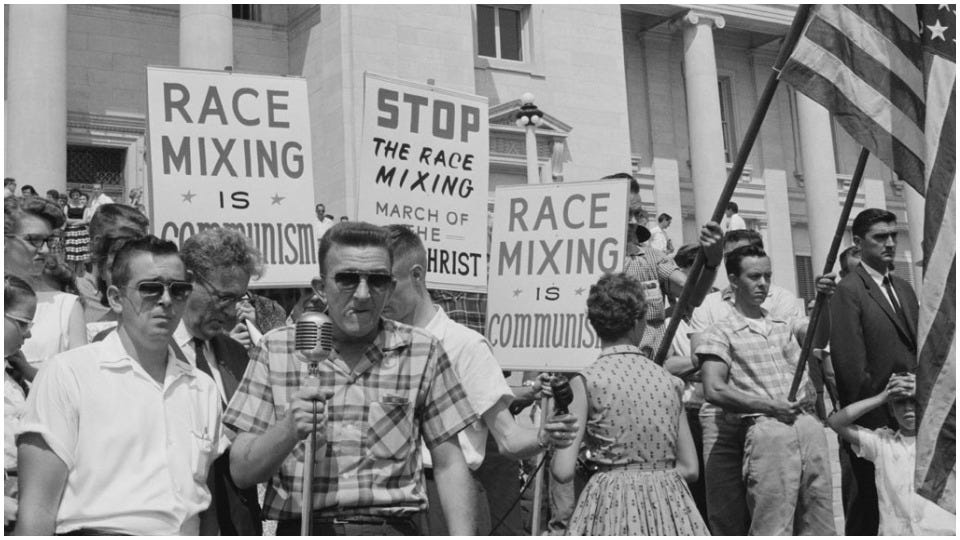
For the sake of this essay, we’ll describe practice as any thought, feeling, or behavior that is repeated on a regular¹ basis. Intentional practice is, therefore, any intentionally repeated thought, feeling, or behavior. So, for the folks captured in the above photo, let’s assume (despite the dangers therein) that they have intentionally created or purchased the signs they’re holding, and that they have intentionally shown up at this venue to make their views known.
Beyond their chosen signs and location, let’s explore this question: To what extent had they intentionally practiced the thought processes and behaviors that led them to want to stop “race mixing” and equate it with communism? Asked differently, was this view the result of a regular, intentional process of exploration and reflection or just something they chose to repeat because it first had been culturally given to them and then it subsequently reinforced these given biases? What had they practiced that got them to this point?
We can practice just about anything: meditation; strength training; nail-biting; yoga; writing; shooting; mindfulness; foot-tapping; reading; an athletic skill; a musical skill; cooking; checking social media; critical thinking; tai chi; relaxing; compassion; (im)patience; curiosity; public speaking; poor or good posture. You get the idea. Sorry if I omitted your favorite practice.
When we choose to practice — when our repeated thoughts, feelings, and/or behaviors are intentional — it makes sense to say that we practice or we have a practice. When we don’t choose what we practice — when our repeated thoughts, feelings, and/or behaviors are unintentional — it makes sense to say that they practice us — we are practiced by them.
All of us, whether we know it or not, are practiced by something. We regularly are at the effect of thoughts, feelings, and/or behaviors that have chosen us, and with no exceptions, these unintentional practices can serve us, harm us, or both serve and harm us. When they harm us, we often call them addictions, and when we call them addictions we tend to conjure images of injected, inhaled, or swallowed substances. But we can be addicted to daydreaming, foot-tapping, falsehoods, fallacies, and nail-biting as well.
In her book, Getting Our Bodies Back, Christine Caldwell describes addiction as “a consistent physical response to a consistently unmet need” — something we do in order not to be present to what is.² In The Myth of Normal, Gabor Maté describes addiction as “a complex psychological, emotional, physiological, neurobiological, social, and spiritual process [that] manifests through any behavior in which a person finds temporary relief or pleasure and therefore craves, but that in the long term causes them or others negative consequences, and yet the person refuses or is unable to give it up.”³ Addictive behaviors tend to arise when something in the present moment is too painful to bear. Unfortunately, unless that causative “something” is recognized for what it is, addictive behavior continues even after the painful moment(s) has (or have) passed. We continue to try to escape that past painful something.
Caldwell writes that addiction is characterized by 1) repetition; 2) a lack of development — no progress is made; 3) lack of satisfaction — the need is not met; 4) lack of completion; and 5) being uncomfortable to watch. Maté points to three characteristics: 1) short-term relief or pleasure and therefore craving; 2) long-term suffering for oneself or others; and 3) an inability to stop.
To summarize, our addictions are repetitive, arise from an attempt to keep us safe, don’t provide long-term development or relief, do provide long-term suffering, and are difficult to stop.
These traits are consistent with the thoughts, feelings, and behaviors that characterize America’s competing narratives and collective Shadow. We are addicted to thoughts, feelings, and behaviors that keep us and our senses of real or imagined identities intact as we try to avoid what’s true. We don’t progress; we are not satisfied; we occasionally get some short-term relief; we suffer in the long-term; and we don’t seem to be able to stop.
It’s definitely uncomfortable to watch.
_____
- “Regular” admittedly is a vague term. For the sake of argument, we’ll say something is a regular practice if it’s engaged at least once a week. That’s quite arbitrary and open to debate since most of what we’re exploring in this essay takes place decidedly more frequently.
- Christine Caldwell, Getting Our Bodies Back: Recovery, Healing, and Transformation through Body-Centered Psychotherapy. Boston: Shambhala, 1996 (44–45).
- Gabor Maté, with Daniel Maté, The Myth of Normal: Trauma, Illness & Healing in a Toxic Culture. New York: Avery, 2022 (224–25).
 Reggie Marra, MA, PCC